One thing I noticed while creating my Professional Learning Network map was how often I rely on other people when I am trying something new. Coworkers, classmates, friends, family, online communities, and professional resources all play a role in how I learn as a teacher. My PLN is not just where I go when I need a major answer. More often, it is where I go for the quick, “Has anyone tried this?” or “Why is this not working?” moments that happen constantly in teaching.
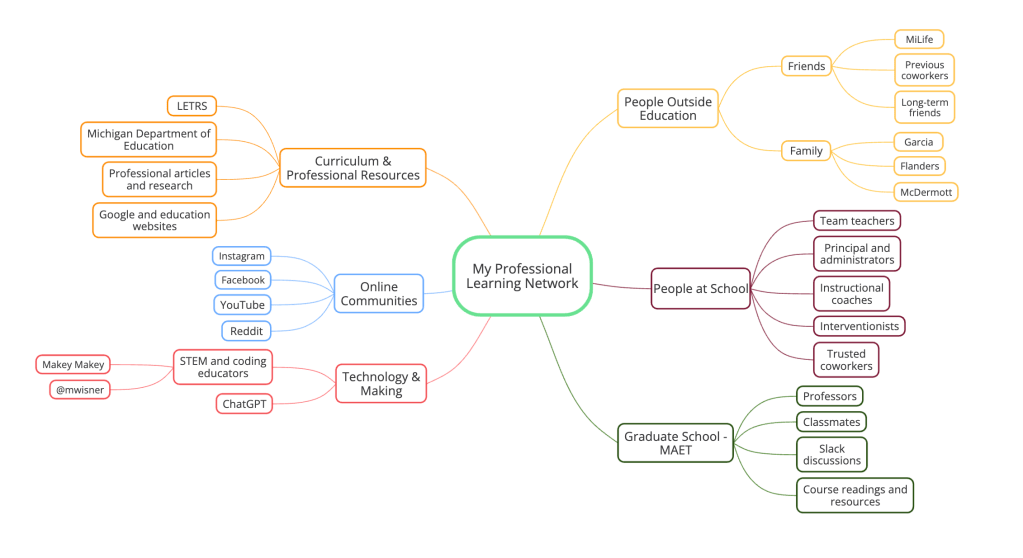
Figure 1. My current Professional Learning Network, created using AYOA, shows the people, communities, tools, and resources I turn to for ideas, support, problem-solving, and professional growth.
While mapping my network, I also realized that AI has started to become part of that process. I have used generative AI to brainstorm lesson ideas, troubleshoot technology, organize information, revise writing, and create visuals. This week, I even experimented with using AI to help organize my PLN into an infographic when the mind-mapping tools I tried were not working the way I wanted them to.
That experience showed me one of AI’s biggest affordances: speed (controversial…I know). When I am planning a lesson or trying to solve a problem, I can ask a question and immediately have something to react to. This does not mean the first response is always what I need, but it gives me a starting point. In that way, AI feels similar to the “just-in-time” support I get from my PLN. It can help me move forward when I might otherwise spend a long time searching for an answer or staring at a blank page.
I also spent some time exploring Google Gemini, specifically NotebookLM. What stood out to me was that it felt a little different from using a general chatbot. I could upload the sources I wanted it to use, and it created supports from those materials rather than pulling from anywhere.
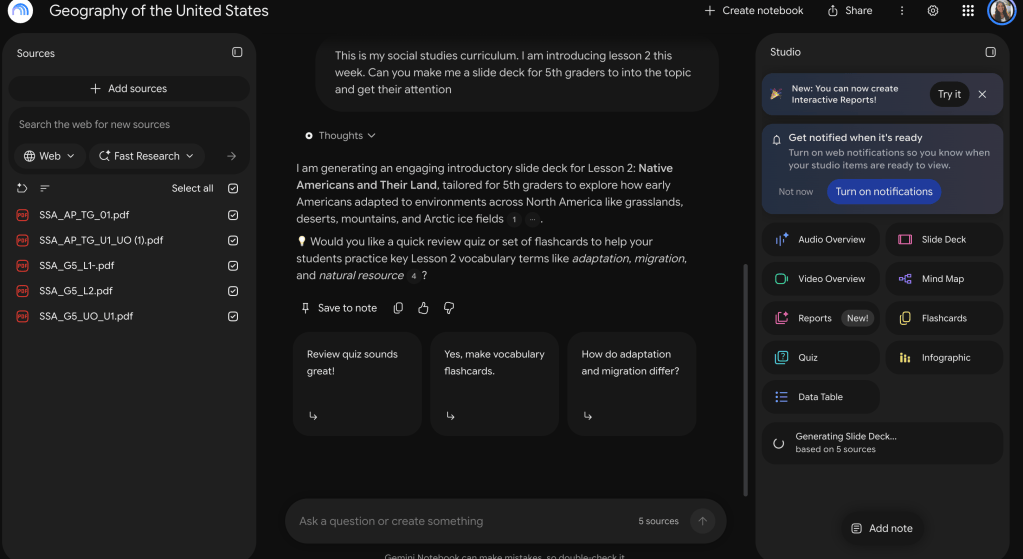
Figure 2. Screenshot of my NotebookLM exploration using uploaded social studies curriculum materials to generate classroom supports.
I still had to fact-check what it produced, but being able to trace the information back to the sources I provided made the process feel more manageable and trustworthy. For teaching, I could see this being useful for creating summaries, study supports, or organizing information from a specific set of materials without losing track of where the information came from.
Figure 3. The product: AI was able to generate an engaging introductory slide deck for lesson 2.
This also connects to connected learning. Ito et al. (2013) describe learning as something that can connect personal interests, relationships, and academic or professional opportunities across different spaces. My PLN works in a similar way. Sometimes I learn from the people in my building, sometimes from graduate school, and sometimes from an online community. The value is not necessarily where the information comes from, but how I connect it back to what I am trying to accomplish in my classroom.
There are also clear constraints. AI can confidently give an answer that is incomplete, inaccurate, or simply not useful. It does not know my students or classroom in the same way that a coworker does. I still have to decide whether an idea fits my learning goal, my students, and the context of the lesson. Henderson et al. (2017) found that students often valued digital technologies for practical benefits like flexibility, organization, and saving time, while cautioning against assuming technology automatically transforms learning. I think the same is true for AI. Being faster does not automatically make something better.
There are also consequences that are easy to overlook. Zewe (2025) explains that generative AI requires significant electricity and water, both when models are trained and when they are used. The article made me think more carefully about how easily I can open an AI tool without thinking about what is happening behind the screen. Winner’s (1980) argument that technologies are not simply neutral tools also feels relevant here. The design and use of technology can shape access, participation, and larger systems in ways we may not immediately notice.
For my teaching, I do not see AI replacing my professional network. Instead, I see it becoming another part of it. It is useful for brainstorming, troubleshooting, creating supports, and helping me try something new, but it still requires professional judgment. My goal is not to use AI simply because it is available. I want to use it when it helps me solve a problem, explore an idea, or create a better learning experience for students.
References
Henderson, M., Selwyn, N., & Aston, R. (2017). What works and why? Student perceptions of ‘useful’ digital technology in university teaching and learning. Studies in Higher Education, 42(8), 1567–1579.
Ito, M., Gutiérrez, K., Livingstone, S., Penuel, B., Rhodes, J., Salen, K., Schor, J., Sefton-Green, J., & Watkins, S. C. (2013). Connected learning: An agenda for research and design. Digital Media and Learning Research Hub.
Winner, L. (1980). Do artifacts have politics? Daedalus, 109(1), 121–136.
Zewe, A. (2025, January 17). Explained: Generative AI’s environmental impact. MIT News.


Leave a comment