When I first designed my innovative learning experience, I envisioned a single lesson where students would use Makey Makey, a physical computing device that transforms conductive objects into keyboard inputs, along with Scratch and Play-Doh to create an interactive vocabulary museum. Students would sculpt a vocabulary word, record an explanation, and invite classmates to guess the word before activating the recording. I loved the creativity of the lesson, but after receiving feedback from my classmates and instructor, I realized something important: I had designed an exciting activity, but I had not designed enough opportunities for students to learn the technology before expecting them to use it.
Explore my complete Innovative Learning Plan
The biggest change I made was transforming the lesson into a week-long learning experience. Instead of introducing Makey Makey and expecting students to create a finished project in a single class period, students now build confidence over five days by exploring circuits, learning Scratch, practicing the technology, and finally applying those skills to create an interactive vocabulary museum.
This redesign was driven by both feedback and research. My instructor encouraged me to scaffold students’ experiences with Makey Makey, while my peer suggested breaking the project into smaller pieces to better support learners. Looking back, I realized I had assumed students could learn unfamiliar technology while simultaneously demonstrating vocabulary understanding. Research supported slowing the process down. Hijón-Neira et al. (2020) found that elementary students benefited from structured guidance and opportunities to gradually develop technical skills before completing larger programming tasks. Rather than making Makey Makey the focus of the lesson, I redesigned the experience so it became a tool students learned to use in service of their vocabulary learning.
The second major change involved assessment. My original plan relied mainly on teacher observations and a final rubric. After reviewing feedback, I realized assessment needed to guide learning rather than simply measure it. The revised unit now includes daily formative assessments, exploration notebooks, teacher conferences, peer feedback, troubleshooting checkpoints, and opportunities for revision before students share their final museum. Huang et al. (2025) found that scaffolded instruction helps elementary students develop confidence and independence while learning new technologies. Instead of viewing mistakes as failures, students are encouraged to troubleshoot, revise, and improve throughout the learning process.
Figure 1. Students use a planning sheet to organize their thinking before building their interactive vocabulary exhibit.
These revisions also strengthened the Universal Design for Learning (UDL) principles embedded throughout the unit. Students may work independently, with a partner, or in a small group while accessing supports such as teacher modeling, visual examples, text-to-speech, flexible grouping, and multiple opportunities for revision. The technology is no longer the centerpiece. Instead, it becomes one pathway students use to demonstrate vocabulary understanding.
One unexpected lesson from this process had nothing to do with Makey Makey or vocabulary. It had to do with me. When I first read the assignment, I built walls in my own thinking. I convinced myself I had to design a single lesson because that was how I initially interpreted the prompt. Once I had that idea in my head, I became hesitant to question it. I worried that changing directions meant I had misunderstood the assignment or made a mistake. It was not until I stepped back, listened to the feedback I received, and explored current research that I realized those walls were entirely self-imposed. Nothing prevented me from expanding my lesson into a week-long learning experience except my own assumptions. Ironically, the biggest redesign wasn’t my lesson. It was my thinking.
Looking back, I still love the idea of an interactive vocabulary museum. What changed is everything leading up to it. Students are no longer expected to immediately succeed with unfamiliar technology. Instead, they build confidence, collaborate with classmates, revise their work, and ultimately create something they are proud to share. The final museum is simply the product. The real innovation happened throughout the process of building toward it.
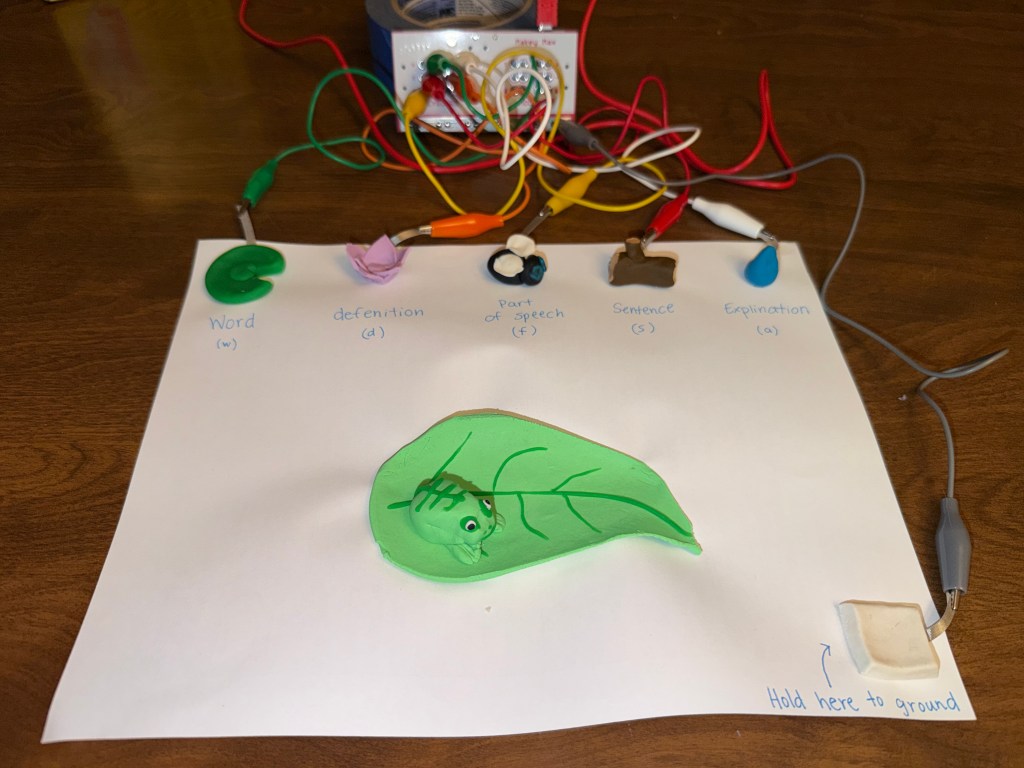
Figure 2. Prototype of the interactive vocabulary exhibit that inspired the week-long learning experience.
That realization extends beyond this lesson. Just as I want my students to see mistakes as opportunities to grow, I had to do the same as a designer. Sometimes the biggest barriers to innovation are not found in the technology, the curriculum, or even the classroom. Sometimes they’re the walls we unknowingly build in our own thinking. This experience reminded me that iteration is not just about improving a lesson. It is about being willing to challenge those walls, rethink our assumptions, and create something better because of it.
References
Hijón-Neira, R., Perez-Marin, D., Pizarro, C., Arredondo, M. T., Rodríguez, P., & Freire, M. (2020). The effects of a visual execution environment and Makey Makey on primary school children learning introductory programming concepts. IEEE Access, 8, 217800-217815. https://doi.org/10.1109/ACCESS.2020.3042319
Huang, Y.-P., Kim, H., Pan, Y., Tseng, Y.-H., Chen, N.-S., & Lin, C.-J. (2025). Promoting elementary school students’ programming learning: Effects of metacognitive vs. cognitive scaffolding. Journal of Research on Technology in Education, 57(4), 914-929. https://doi.org/10.1080/15391523.2024.2332110
 Alexis Flanders
Leave a comment